
Vietnam Visa for Japanese Citizens
Japanese visitors are some of Vietnam's most loyal travellers: 814,169 arrived in 2025, and 757,468 came between January and October 2026. Non-stop flights from Narita, Haneda, Kansai, Chubu and Fukuoka reach Hanoi, Ho Chi Minh City and Da Nang in roughly six hours, and with so many Japanese companies operating in Vietnam, plenty of those trips mix business meetings with a few days in Hoi An's old town, on Ha Long Bay or on the beaches of Da Nang. Japanese citizens can visit for up to 45 days without a visa, so you'll only need one for a longer stay or if you're coming to work.
Do Japanese Citizens Need a Visa for Vietnam?
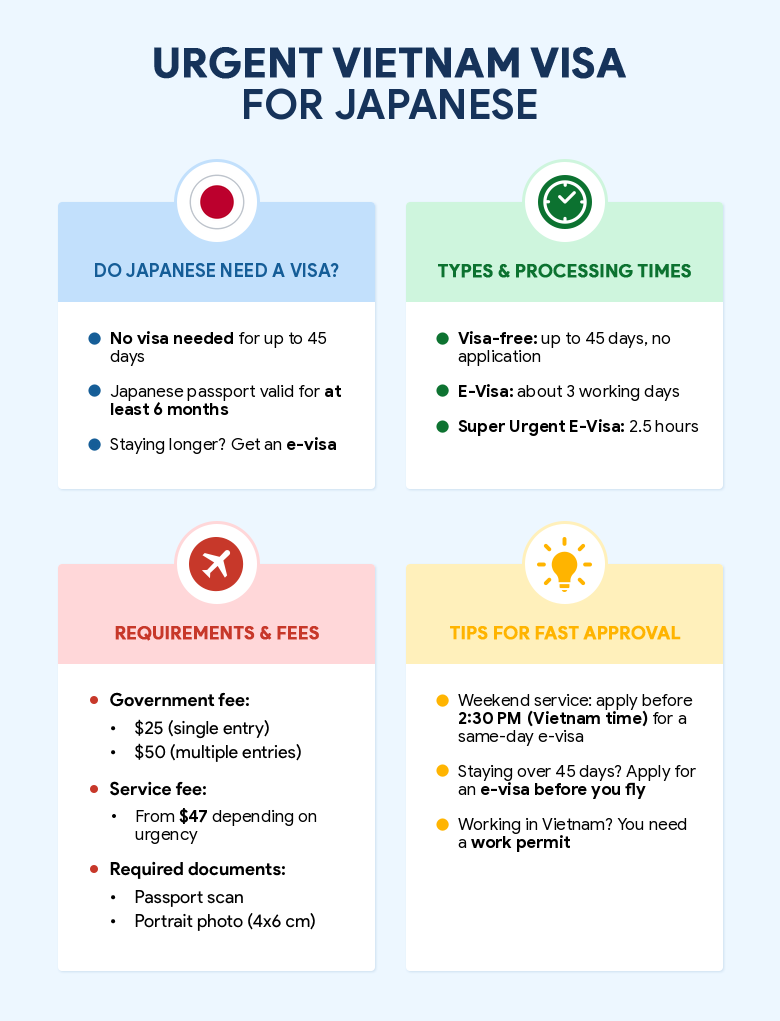
Japanese passport holders don't need a visa for stays of up to 45 days, whether they're coming for tourism, business meetings, conferences or family visits. The exemption is granted under Government Resolution 44/NQ-CP, which runs until 14 March 2028. The 45 days count from your arrival day.
Things to check before you go:
- Your passport needs at least 6 months of validity remaining on the day you arrive.
- A visa-free entry covers short business trips such as meetings and site visits, but not employment. If you're being posted to a company in Vietnam, you'll need a work permit and the right visa.
- The exemption applies to Japanese passports. Non-Japanese residents of Japan follow the rules for their own nationality.
When a Visa Is Still Required
Arrange a visa or e-visa before departure if:
- your stay will be longer than 45 days, for example an extended business assignment or a long holiday
- you're starting a job, studying or investing in Vietnam
- you're a foreign resident of Japan travelling on another country's passport
For trips of up to 90 days, an e-visa is usually the fastest solution.
Choosing the Right Visa for Your Trip
Most Japanese visitors don't need to apply for anything. When a trip goes beyond the visa-free rules, the choices are an e-visa, a visa on arrival, or a visa from Vietnam's embassy in Tokyo or its consulates general in Osaka and Fukuoka.
| Visa Type | Validity | Entries | Fee (approximate) |
|---|---|---|---|
| Visa exemption | Up to 45 days per visit | Each entry | Free |
| E-visa (single entry) | Up to 90 days | Single entry | USD 25 (approximately JPY 4,000) |
| E-visa (multiple entry) | Up to 90 days | Multiple entry | USD 50 (approximately JPY 8,000) |
| Visa on arrival | Up to 90 days for tourism | Single or multiple entry | From USD 25 stamping fee, plus the approval letter fee |
| Embassy or consulate visa | Depends on the visa type | Single or multiple entry | Set by the embassy or consulate |
Note: extending a visa-free stay from inside Vietnam is only possible through a sponsor, such as a company or travel agency, and approval is at the authorities' discretion. Applying for an e-visa in Japan before your trip avoids that uncertainty. The fee is set in US dollars, so what you pay in yen depends on your card issuer's exchange rate.
Entering Vietnam Visa-Free: What to Bring
- Your Japanese passport, valid for at least 6 months after arrival and with two empty pages
- Proof of onward travel within 45 days, such as your return flight to Japan
- Details of where you'll stay on your first night
Applying for an E-Visa Before a Longer Trip
If your plans go beyond 45 days, get the e-visa sorted before you leave Japan:
- Open the official e-visa portal at evisa.gov.vn
- Select the application for foreign nationals and read the guidance
- Upload a recent 4x6 cm photo with a white background and no glasses, plus a scan of your passport photo page
- Enter your name and passport details exactly as printed in your passport, in the same romanised spelling
- Pick single or multiple entry, set your dates (up to 90 days) and choose your port of entry
- Pay the fee online and note down your registration code
- Follow progress at evisa.gov.vn/e-visa/search. Expect around 3 working days, not counting weekends or Vietnamese public holidays
- When it's approved, download and print the e-visa, and check that every detail matches your passport
Only the government portal issues e-visas. Copycat websites can look very similar but charge more for the same thing.
Need Your Vietnam Visa Urgently?
When a business trip suddenly runs past 45 days, or you need a visa for a departure only a few days away, we can process it within hours. Our urgent service runs Monday to Friday, on Vietnamese working days:
- Expedite an e-visa you've already submitted: from USD 50 (about JPY 8,000), ready in as little as 2.5 working hours
- New e-visa application: from USD 47 (about JPY 7,500), ready in as little as 4 working hours
- Urgent visa on arrival approval letter: from USD 65 (about JPY 10,400) plus the USD 25 stamping fee, ready in as little as 2 working hours
- Weekend processing: USD 160 to USD 235 (about JPY 25,500 to JPY 37,500), same day for requests received before 2:30 pm Vietnam time
Japan is 2 hours ahead of Vietnam: when our office opens at 8:00 am, it's already 10:00 am in Tokyo.
Visa on Arrival for Short-Notice Trips
Japanese visitors rarely need a visa on arrival. It can still help if you're flying in and need a visa for longer than 45 days at very short notice. A Vietnamese sponsor or visa service obtains the approval letter in advance, and at the airport you present it at the landing visa desk before immigration, together with your passport, an NA1 application form, one 4x6 cm photo and the USD 25 stamping fee in cash for a single-entry visa. It isn't available at land or sea borders.
Contacting the Vietnamese Embassy and Consulates in Japan
For work visas, long stays or anything more complex, contact Vietnam's embassy in Tokyo or one of its consulates general. Hours and requirements can change, so check before you go.
Embassy of Vietnam in Tokyo
- Address: 50-11 Motoyoyogi-cho, Shibuya-ku, Tokyo 151-0062, Japan
- Phone: +81 3 3466 3311 or +81 3 3466 3313
- Fax: +81 3 3466 7652
- Email: vnembasy@blue.ocn.ne.jp
- Website: https://vnembassy-tokyo.mofa.gov.vn/
Consulate General of Vietnam in Osaka
- Address: 4-2-15 Ichinocho Higashi, Sakai-ku, Sakai, Osaka 590-0952, Japan
- Phone: +81 72 221 6666
- Fax: +81 72 221 6667
- Email: tlsqvn.osaka@mofa.gov.vn
- Website: https://vnconsulate-osaka.mofa.gov.vn/
Consulate General of Vietnam in Fukuoka
- Address: 4F Aqua Hakata, 5-3-8 Nakasu, Hakata-ku, Fukuoka 810-0801, Japan
- Phone: +81 92 263 7668
- Fax: +81 92 263 7676
- Email: tlsqvn-fukuoka@mofa.gov.vn
- Website: https://vnconsulate-fukuoka.mofa.gov.vn/
The Osaka consulate general is in Sakai city, south of central Osaka, so allow extra travel time if you're visiting in person.
Practical Notes for Japanese Visitors
- Register your trip with the Ministry of Foreign Affairs of Japan's Tabireg service so you receive safety updates while you're away
- Before you fly, you can fill in Vietnam's free pre-arrival declaration at prearrival.immigration.gov.vn up to three days ahead. It isn't mandatory yet, but it can save time at passport control in the big airports. Avoid unofficial look-alike sites
- If you need an e-visa, apply well before Tet (Lunar New Year, usually in late January or February), when Vietnamese government offices close for about a week
- On a business trip, carry a letter from your company or your meeting schedule, as immigration officers sometimes ask about the purpose of a visit
- Before leaving the immigration counter, look at the date stamped in your passport: that's the last day you may stay
Frequently Asked Questions
How often can I visit Vietnam visa-free?
As often as you need to. There's no required gap between visa-free visits, which suits frequent business travellers, although immigration decides on each entry.
Can I drive in Vietnam with a Japanese international driving permit?
No. Japan issues international driving permits under the 1949 Geneva Convention, while Vietnam only recognises permits issued under the 1968 Vienna Convention. Most visitors use taxis, ride-hailing apps or a car with a driver instead.
Can I start working while my work permit is being processed?
No. Unless your job is exempt from a work permit under Vietnamese law, you need the permit and a matching work visa before you start working.
Can my family come with me visa-free?
Yes. Family members with Japanese passports each get their own 45-day visa-free stay. Relatives of other nationalities should check the rules for their own passports.
Get Your Vietnam Visa with Urgent Vietnam Visa
Whether you're heading to Hanoi for meetings or to Da Nang for a family holiday that has grown longer than planned, Urgent Vietnam Visa can help. Our local team has been arranging Vietnam e-visas and visa on arrival letters since 2007, including same-day requests. Apply online in a few minutes and we'll keep you updated until your visa is ready. Start your application here.
