
Vietnam Visa for Indians
Vietnam has quickly become a leading destination for Indian travellers, with arrivals rising from 145,340 in 2023 to 501,427 in 2024 and reaching 746,480 in 2025. As of 2026, Indian passport holders still require a valid visa in most cases. The best option—whether the widely used 90-day e-visa or a visa issued via the Embassy/Consulate—depends on your itinerary, intended entry point, and length of stay.
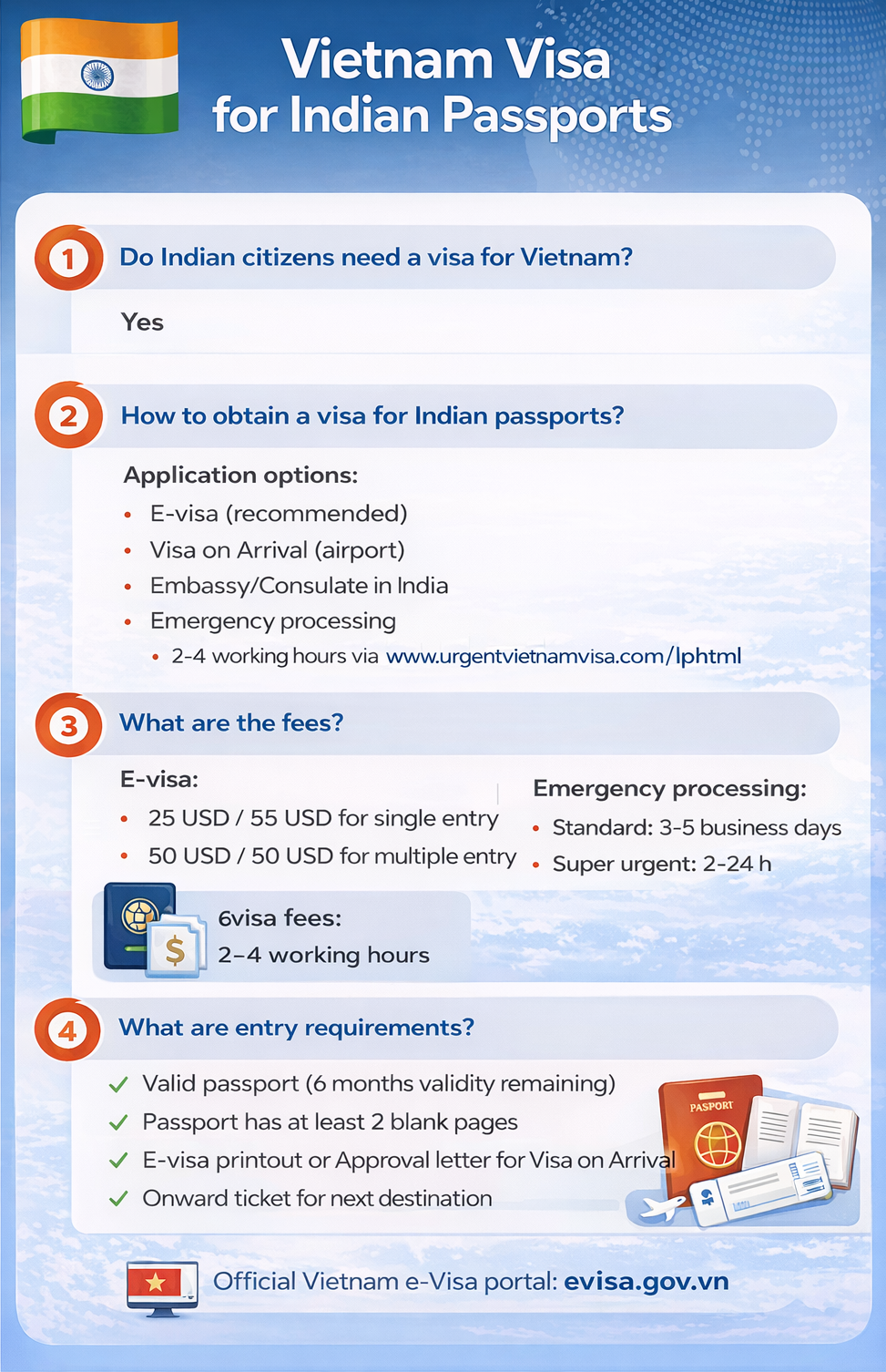
Do Indians need a visa for Vietnam?
Yes. Indian citizens need a visa to enter Vietnam, unless they qualify for a limited special exemption (for example, Phu Quoc under strict conditions). For most travellers, the simplest approach is to apply for a Vietnam e-Visa before departure.
Vietnam visa options for Indian citizens
Below are the three most common ways Indians apply for a Vietnam visa:
| Option | Best for | Key notes |
|---|---|---|
| e-Visa (online) | Tourism & short trips; most travellers | Up to 90 days; single or multiple entry; accepted at many entry points (choose the correct one on the form). |
| Visa on Arrival (VOA) | Air entry; when you prefer an agency-supported workflow | Airport-only; requires approval letter before boarding; stamping at airport on arrival. |
| Embassy/Consulate visa | Special cases; when you want official confirmation or specific visa types | Apply via Vietnam Embassy/Consulate in India; requirements vary by purpose; allows direct consular guidance. |
Option 1: Vietnam e-Visa (Recommended)
The Vietnam e-Visa is usually the easiest and most cost-effective method for Indian citizens. You apply online, receive the visa electronically, then print it for check-in and immigration.
- Validity: up to 90 days
- Entry type: single-entry or multiple-entry
- Important: select the correct port of entry in your application
Official Vietnam e-Visa portal: https://evisa.gov.vn/
In emergency cases, Indian passport holders can obtain an urgent visa within 2–4 working hours through our service at: https://www.urgentvietnamvisa.com/apply.html
Option 2: Visa on Arrival (VOA) (Airport only)
Visa on Arrival can work if you enter Vietnam by international flight. You must obtain a visa approval letter before your flight (commonly arranged through a licensed visa service), then receive the visa sticker at the airport on arrival.
- VOA is for air entry only (not land/sea borders)
- You must have the approval letter before boarding
- On arrival, you complete visa stamping procedures and pay applicable stamping fees
Option 3: Embassy / Consulate visa (India)
If you need a visa for a specific purpose (business, work, long stays, complex cases) or you want official, case-by-case confirmation, you can apply through Vietnam’s diplomatic missions in India. Contact details below are provided for convenience; always confirm working hours and requirements before visiting.
Embassy of Vietnam in New Delhi
- Address: EP-7A, Chandragupta Marg, Chanakyapuri, New Delhi - 110021, India
- Office Tel: +91 11 2687 9868
- Office Fax: +91 11 2687 9856
- Consular Tel: +91 11 2687 9858 (as published: typically answered 14:30–18:00 on weekdays)
- Consular Fax: +91 11 2687 9869
- Email: info@vietnamembassydelhi.in
- Website: https://vietnamembassydelhi.in/
Consulate General of Vietnam in Mumbai
- Address: Unit 805, 8th Floor, Powai Plaza, Hiranandani Gardens, Central Avenue, Powai 400076, Mumbai, India
- Phone: +91 22 2570 2033
- Fax: +91 22 2570 2034
- Email: tlsq.mumbai@mofa.gov.vn
- Website: https://vnconsulate-mumbai.mofa.gov.vn/
Note: Some directories may list alternative/legacy embassy addresses. For the most reliable details, use the Embassy/Consulate official websites above.
Requirements checklist (Typical)
Exact requirements can vary by visa type. For most tourist e-Visa applications, prepare:
- Passport bio page scan (clear and readable)
- Passport-style portrait photo (recent, clear background)
- Basic itinerary information (entry/exit dates, accommodation)
- A valid email address for receiving results
- Online payment method (for e-Visa fee)
Processing time
- e-Visa: often processed in 3-5 working days (plan extra time for weekends and public holidays).
- VOA approval letter: depends on provider and urgency level.
- Embassy/Consulate visa: varies by visa type and consular workload.
Fees & cost notes
- e-Visa government fee: commonly shown as USD 25 (single-entry) / USD 50 (multiple-entry) on the official portal.
- VOA: typically includes (1) service fee for approval letter + (2) stamping fee at the airport.
- Embassy/Consulate: fees depend on visa type and the mission’s schedule of charges.
Special case: Phu Quoc 30-day visa exemption
Currently, Indian passports may enter Phu Quoc visa-free for up to 30 days if they meet strict conditions (routing and stay requirements). If your itinerary includes mainland Vietnam (e.g., Hanoi, Ho Chi Minh City, Da Nang), you should obtain a visa (e-Visa is usually simplest).
Common mistakes to avoid
- Typing passport details incorrectly (full name order, passport number, date of birth)
- Selecting the wrong visa type (single vs multiple entry)
- Choosing an incorrect port of entry for e-Visa
- Applying too close to departure (risk increases around weekends/holidays)
FAQ
Can Indian citizens get a Vietnam visa on arrival?
Yes, if you enter Vietnam by air and you have an approval letter before boarding. VOA is not intended for land or sea entry.
Which is better for Indians: e-Visa or VOA?
For most travellers, e-Visa is simpler because it is official, online, and avoids airport stamping queues. VOA may be useful in specific scenarios where an agency-supported approval letter is preferred.
Should I apply for a visa at the Embassy/Consulate in India?
If your case is special (business/work, complex documentation, or you want official clarification), contact the Embassy/Consulate directly. They can confirm requirements for your exact purpose of travel.
